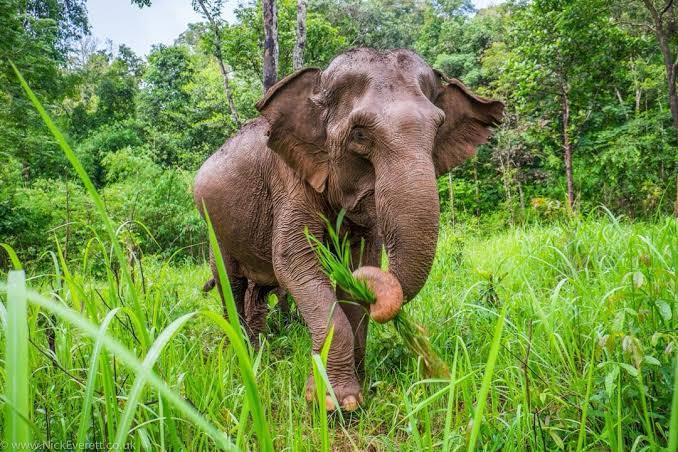
You may encounter the wild population of the Asian elephant (Elephas maximus) during your trek or along the river.
Quick facts:
- About 3,000–3,500 wild elephants live in 69 protected areas across Thailand.
- Around 3,700–3,800 are domesticated, so there are only about 6,700 elephants total in the country.
- Their biggest threats are habitat loss, forest fragmentation, and human–elephant conflict.
- They are classified as Endangered on the IUCN Red List.
- Each elephant can eat 100 to 200 kg of food per day leaves, bamboo, bark, and fruit.
- They may drink up to 200 liters of water daily.
- Adult males can weigh 3,000–4,000 kg or more, depending on age and condition.
Safety around elephants:
If you see an elephant whose ears are gently flapping and body is relaxed, it’s calm and comfortable.
If there’s a mahout (caretaker) nearby, you’re safe as long as you follow their lead.
However, if there’s no mahout, keep your distance.
If its ears are flared wide, or it’s swaying its head, raising its trunk, or trumpeting, those are signs of agitation. Stay calm, back away slowly, and give it plenty of space. If you’re trekking, find another route around it.
You may also come across a male elephant in musth sometimes called musking.
This is a natural condition that happens when a bull’s hormone levels rise, making him restless, more mobile, and often aggressive.
How to recognize musth:
- You may see dark, tar-like fluid (called temporin) seeping from the temporal glands on the sides of the head.
- You might also notice urine dribbling and a strong musky smell clear sign to stay well away.
- During musth, elephants can become unpredictable and dangerous. In villages, mahouts sometimes chain bulls to large trees or move them to open pasture until the phase passes.
If you see a male elephant showing these signs, do not approach.
Sometimes, you’ll meet a villager hiking with his elephant that’s perfectly safe.
Enjoy the experience, take photos, and follow the villager’s signals.
If he motions you to move off the trail, do so, and never stand between an elephant and an immovable object like a tree, wall, or car, so you don’t get pinned accidentally.
With awareness and respect, elephants are incredible to see a true highlight of your time in the jungle.