
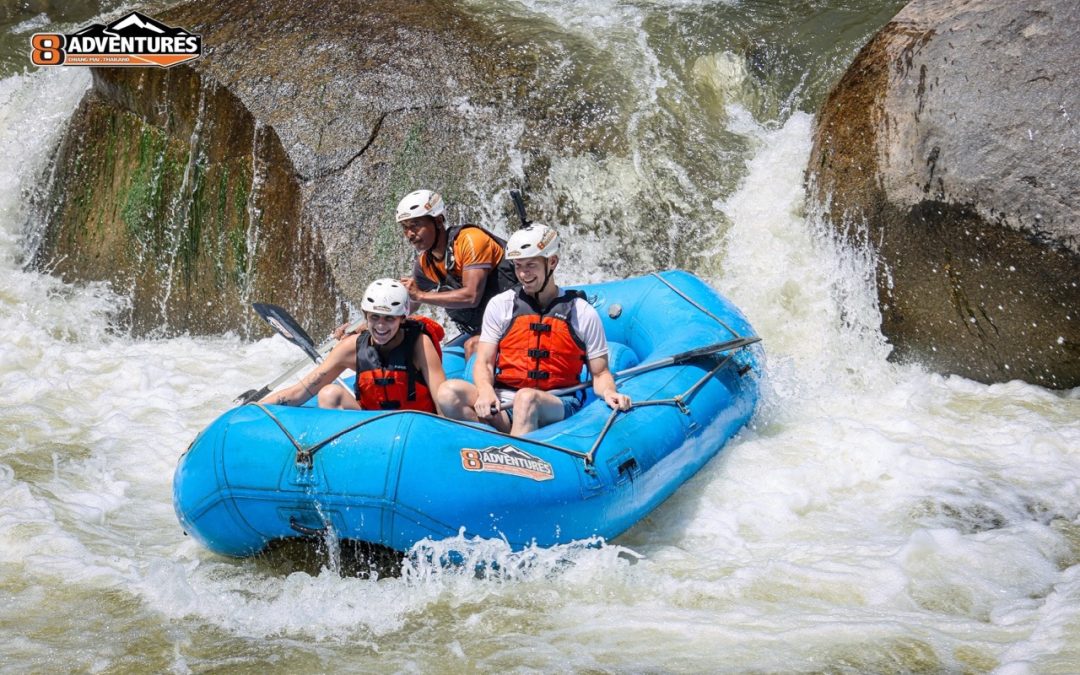
White water rafting in Chiang Mai is one of those experiences that feels far removed from the city, even though it’s only a short drive north. Within about 90 minutes, the roads wind into the Mae Taeng valley, where the river cuts through dense forest and low mountains, creating some of the most consistent rafting conditions in Thailand.
The Mae Taeng River runs year-round, fed by mountain water, and it rarely looks the same twice. In the rainy season it can turn a deep reddish colour as sediment washes down from the hills, giving it what some people refer to as “red water rafting.” In the cooler months, its often crystal clear and slows slightly, but still keeps enough flow to make the experience engaging.
What surprises most people is how continuous the river is. This isn’t a short burst of rapids followed by long flat sections. The Mae Taeng has a rhythm to it — stretches of faster water building into technical sections, then easing off just enough before the next sequence begins.
A typical day starts with pickup in Chiang Mai and the drive into the valley. By the time you reach basecamp, the temperature has usually dropped a little, the air feels cleaner, and the landscape has shifted completely from urban to rural. After a detailed safety briefing and getting fitted with equipment, you head down to the river and ease into the first section, which is designed to let people get comfortable with paddling and commands before the pace picks up.
From there, the river gradually builds. On the longer 10KM oute, the experience leads into a sustained section of Class III–IV rapids where the water moves faster, the drops are more defined, and each raft works as a coordinated unit. It’s the kind of section where timing matters, and where the guide’s experience becomes very obvious. After that, the river relaxes again, giving space to enjoy the surroundings before the final stretches back toward base.
There are two main rafting options, and the difference between them is straightforward. The full 10 km route includes the most intense section of the river, where the largest rapids are concentrated. The shorter 8 km option follows the same river but exits before that section, making it a better fit for families or anyone who wants a slightly more relaxed version of the experience without losing the character of the river.
One detail that often goes unnoticed but makes a real difference is how the boats are used. Depending on water levels, group size, and conditions on the day, raft sizes are adjusted to keep the experience balanced — stable enough to feel safe, but still responsive in the water. It’s a small operational decision that has a big impact on how the river actually feels.
In terms of safety, rafting on the Mae Taeng is well established, but not all operations are equal. 8Adventures is currently the only company in Thailand accredited by the International Rafting Federation, which sets a higher standard for guide training, safety procedures, and overall operation. All guides are local, with deep familiarity of the river across different seasons, which is particularly important here because conditions do change throughout the year.
For families, this setup works especially well. The river offers enough flexibility to adapt the experience, and the 8 km route allows younger participants or first-time rafters to enjoy the day without committing to the most demanding sections. At the same time, the full route still delivers a proper adventure for those who want it.
Seasonally, the experience shifts rather than stops. From roughly July through February, water levels are stronger and the rapids are at their best, especially after periods of rain. Between March and June, the river becomes gentler, but still flows enough to run trips, just at a slower pace. The advantage of this is that rafting in Chiang Mai isn’t limited to a short window — it’s something that can be done almost any time of year, just with a slightly different character.
By the end of the day, most people are surprised by how complete the experience feels. It’s not just about the rapids, but the combination of landscape, movement, and the gradual immersion into the environment. You start the morning in the city and finish having spent hours moving through a river valley that feels far more remote than it actually is.
For anyone visiting Chiang Mai in 2026, rafting remains one of the few activities that genuinely combines accessibility with a real sense of adventure — and the Mae Taeng River continues to be the place where that happens.