
RAFTING 101 · LEARN THE LINGO
River Features ExplainedWhat Your Guide Means by River Left, Eddies, Tongues, and Holes
A small shared vocabulary lets everyone in the boat mean the same thing at the same moment.
PICTURE THIS
You’re in the front of the raft. Your guide points and says…
“Stay right of that hole, then catch the eddy behind the rock on river left.”
Sounds like another language, right?
It’s not that hard, though. A guide isn’t describing scenery. They’re describing moving water and where it wants to go. A small shared vocabulary lets everyone in the boat mean the same thing at the same moment.
So let’s walk through one imaginary rapid, top to bottom, the way a guide would. We’ll define each word right when you’d need it.
FOLLOW THE RAPID, TOP TO BOTTOM
STEP 01 · GET YOUR BEARINGS
First, Which Side Is “River Right”?
This one trips up almost everyone, so it comes first.
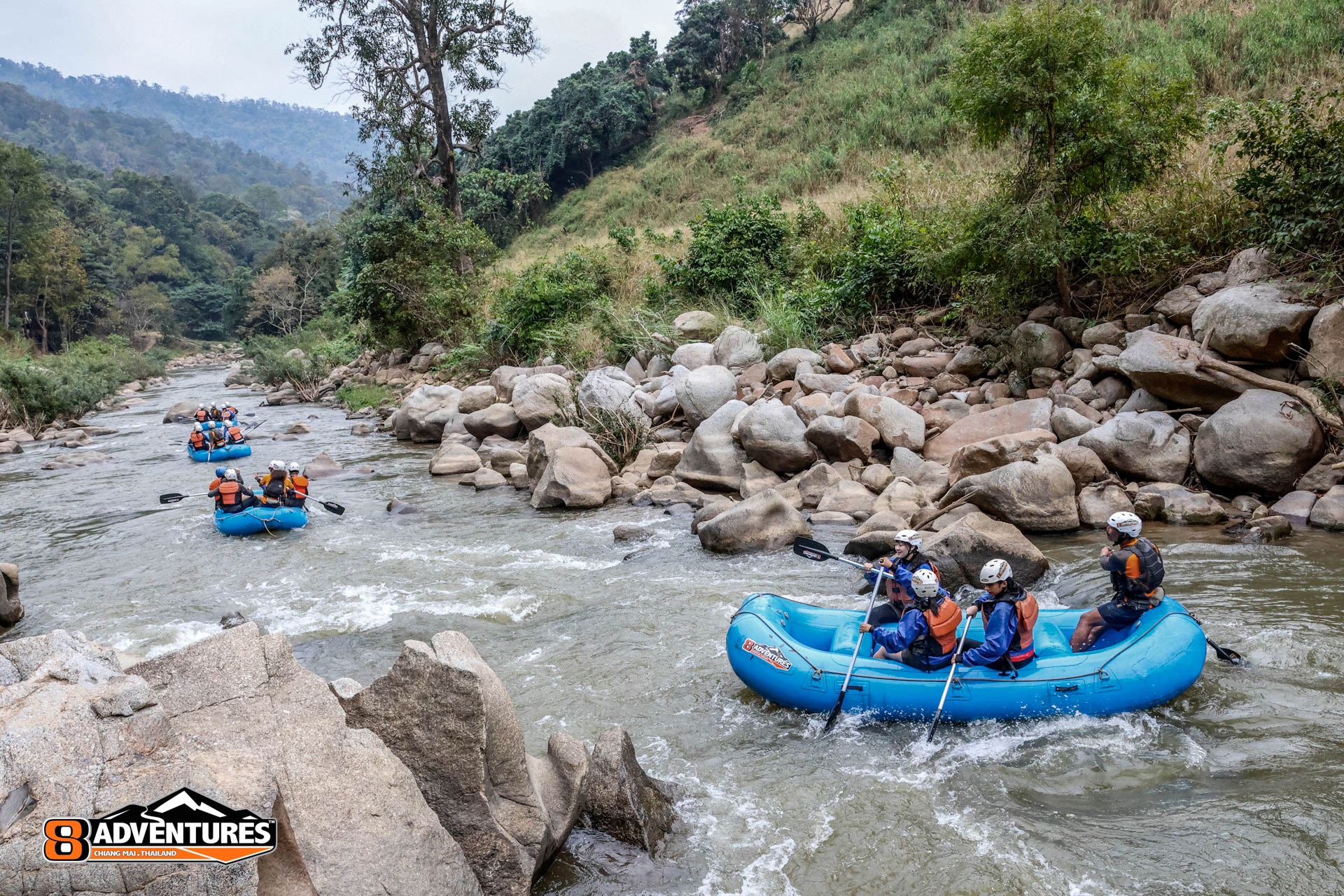
River right is the right bank when you’re looking downstream.
Not your right. Not the guide’s right. Not the right side of your photo.
Say you spin around in the raft and face upstream. The bank on your left hand is still called river right. It doesn’t flip when you turn.
Why does it matter?
In a raft, the guide, the paddler up front, and a swimmer in the water might all be facing different ways. “Left” and “right” would mean three different things. “River left” and “river right” mean one thing, always. Two people who can’t even see each other still agree on which bank.
You may also hear “right of the river” in casual talk. That’s a bit fuzzy, since it could mean the bank or the right-hand half of the current. Guides stick with “river right” and “river left” for that reason.
QUICK TRICK
Face the way the water is going. Now point. That’s your answer.
STEP 02 · STAY IN THE MEAT
The Main Current
Now look at the river itself. Most of the water is moving downstream in one big, strong flow. That’s the main current. Some guides call it “the meat.”
In a bend, the main current usually swings toward the outside bank. That side tends to be faster and deeper. The inside of the bend is slower, and that’s where calm pockets often form.
WHY YOU CARE
Because the main current is the river’s highway. If your guide says “stay in the main current,” they usually want you in the deep, clear channel, away from the shallow edges where rocks hide.
STEP 03 · THE WAY IN
The Tongue: The Smooth Part Before the Splash

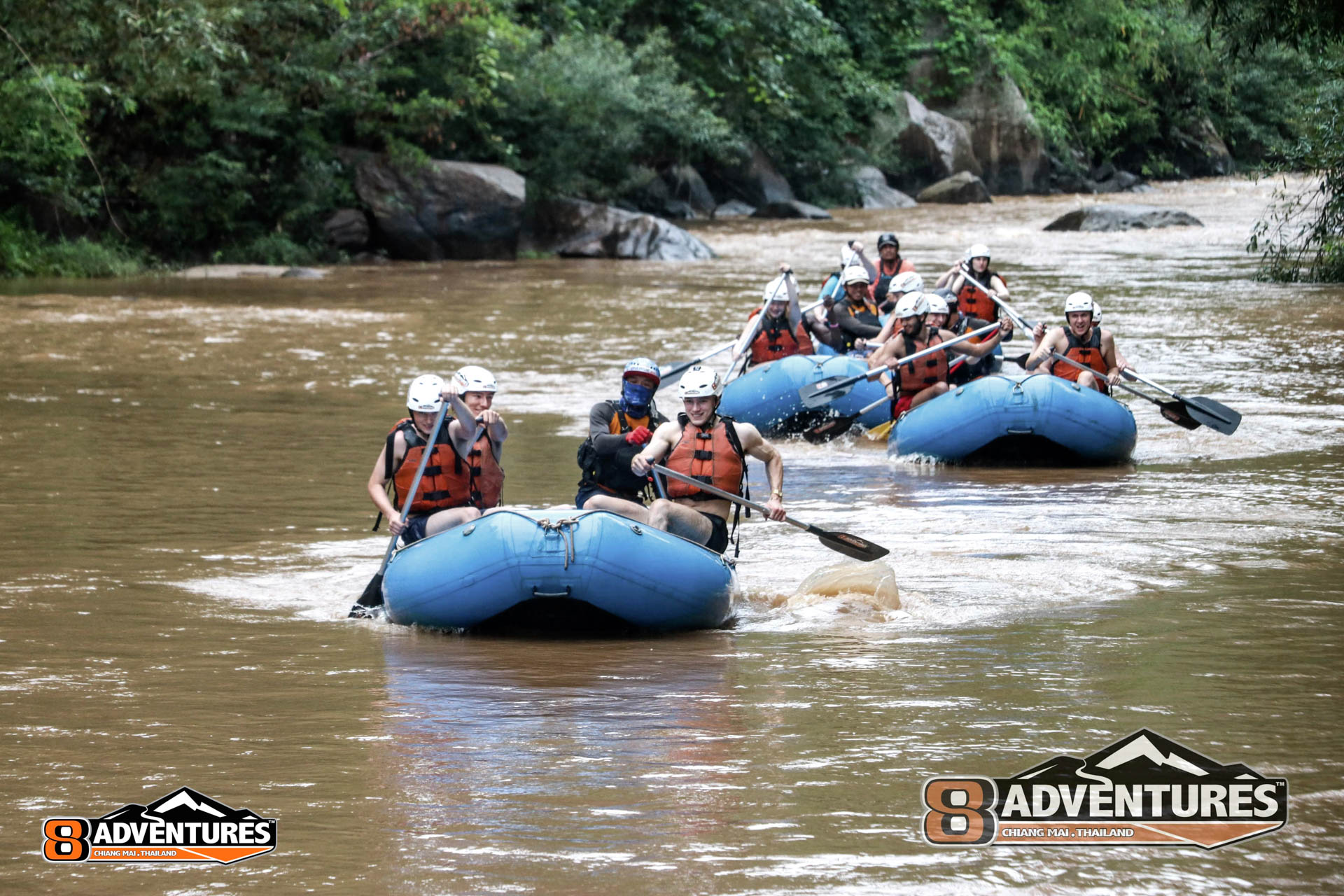
Look at the top of a rapid and you’ll often see a smooth, darker streak of water pointing downstream. It looks like a “V” with the point heading away from you. That’s the tongue.
It means the water is funneling through a clear, deeper gap. A lot of the time, that’s the line a guide wants to take into the rapid.
Here’s the catch
The tongue is not a wave. It’s smooth, fast water, not a pile of whitewater. You might hear someone say “tongues of waves,” and it’s not a standard term. Guides usually mean one of two things: the tongue that leads into a wave train, or the smooth green face of a wave just before it breaks. We’ll keep “tongue” and “wave” as two separate words here, because mixing them up causes confusion.
The Basic Grammar of Reading a River
DOWNSTREAM V
A Gap
The tongue. Smooth, darker water with the point heading away from you, funneling through a clear, deeper gap.
UPSTREAM V
An Obstacle
There’s also a flip side. An upstream V points the other way. The tip aims upstream, toward you. That’s water splitting around something, usually a rock.
STEP 04 · THE FUN BUMPY PART
Waves
Below the tongue, the water starts to heave up and down. That’s the part that feels like a roller coaster, except you’re the one steering.
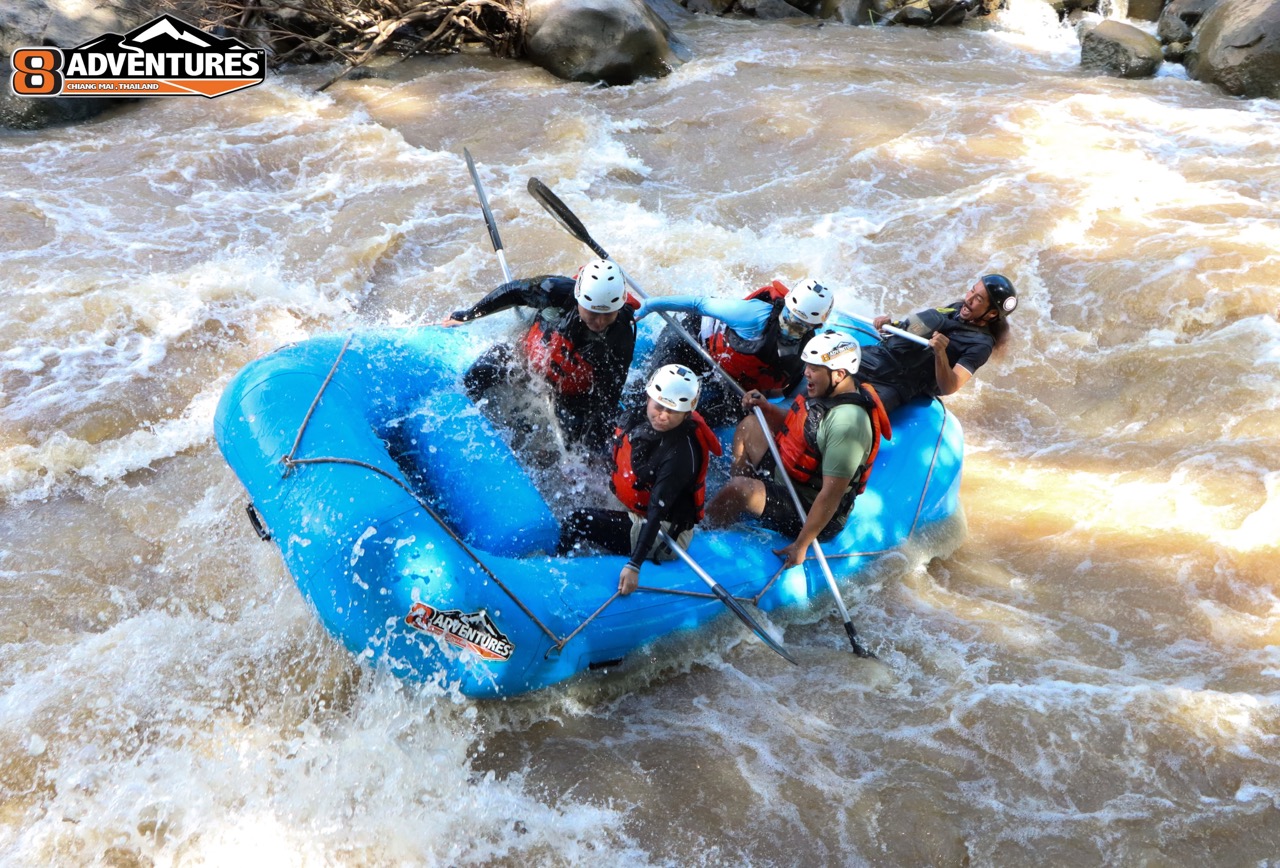
Most waves in a rapid are standing waves. The wave stays roughly in one place while the water rushes through it. Your raft rises up the face, drops into the trough, and does it again. A row of them is a wave train.
WHAT DOES IT FEEL LIKE?
Bouncy. Splashy. Cold water in your face, then laughing. It’s what most people picture when they think rafting.
A few related words you might hear:
Laterals
Waves that peel off a bank or rock at an angle instead of running straight across the river.
Haystacks
Big, piled-up, messy standing waves. You hear this more on large, high-volume rivers.
Meanwhile, your guide is watching something different. They’re checking that the raft is still lined up on the tongue and still clear of whatever’s lurking off to the side.
STEP 05 · WHITE WATER THAT PULLS BACKWARD
The Hole
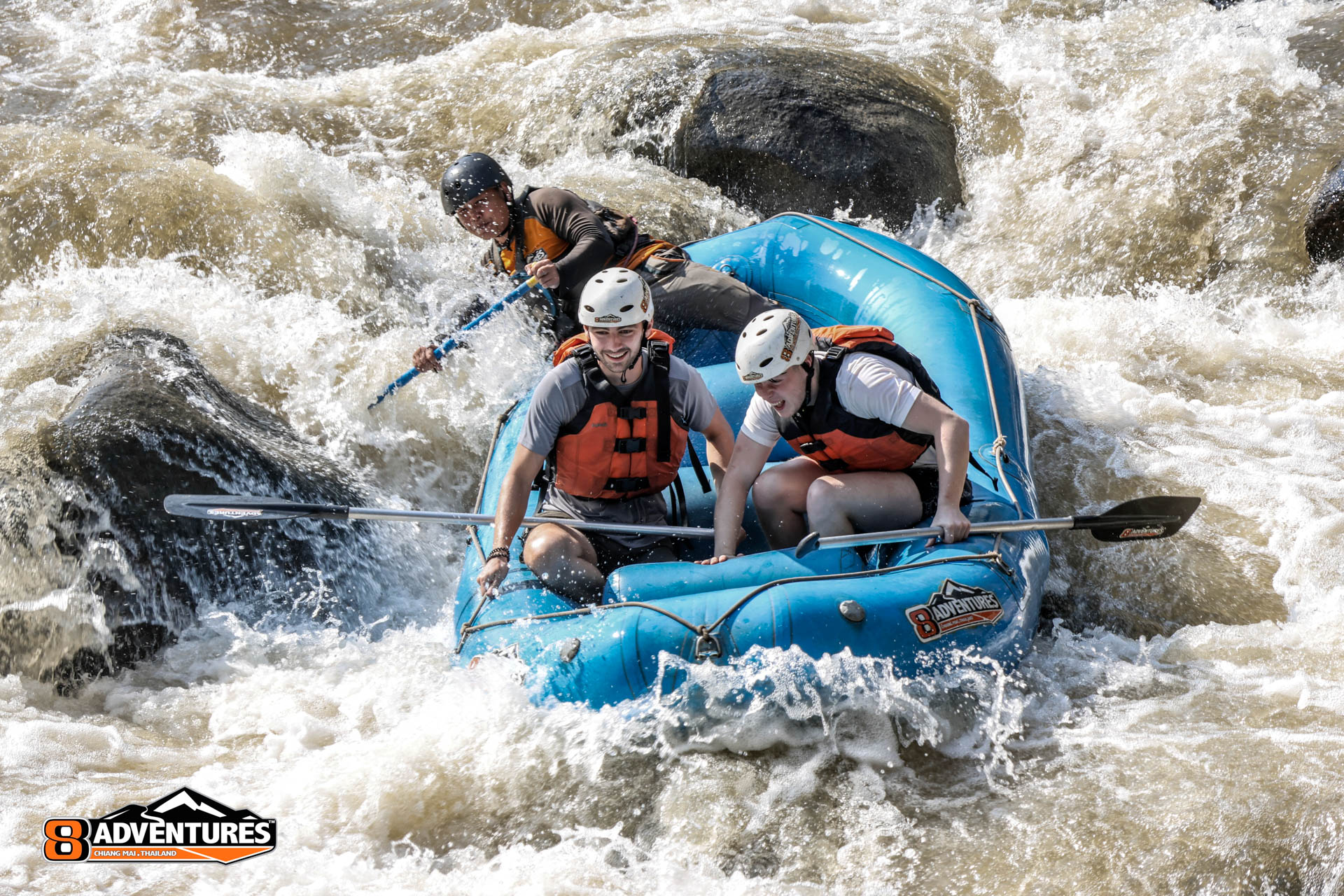
Now look beside the wave train. See that patch of white, frothy water at the base of a drop? That might be a hole.
Here’s how it works
Water pours over a rock or ledge and dives down. Then the surface water curls back upstream into a foamy pile. That backward flow is what makes a hole different from a wave.
A wave moves water through it, mostly downstream. A hole has water on top flowing back toward the drop.
Holes go by a few names. You’ll hear hydraulic, reversal, and stopper, and they can all mean the same feature. Different regions and guides just talk differently. There’s no single dictionary for this sport.
NOT ALL HOLES ARE BAD NEWS
Flushy
A raft pops right through.
THE ONES TO RESPECT
Sticky (Keepers)
A keeper can hold a raft, or a swimmer, in place. And the same hole can behave very differently depending on how much water is in the river.
So no, “hole” doesn’t automatically mean “danger.” It also doesn’t automatically mean “fun bounce.” That’s why your guide picks the route, not you. If your guide says to stay away from one, stay away from it.
What About U-Shaped Holes?
“U-shaped hole” is guide slang. It’s not an official category. It just means the hole curves, like a horseshoe. Guides often split these into two types:
THE ENDS POINT DOWNSTREAM
A Smile
The edges (called shoulders) are often a way out.
THE ENDS POINT UPSTREAM
A Frown
The current pushes things back toward the middle, which can make it stickier.
So is a U-shaped hole “the good kind”? Not necessarily. The shape is just a clue. How much water is dropping, how big the drop is, and whether the backwash runs continuously across all matter more.
ONE MORE THING
A Low-Head Dam Is Not a Fun Hole
It’s a river-wide hydraulic, often hard to see from upstream and with no real edges to escape through. Dam-safety folks have a grim nickname for them. A rapid on a guided trip is a totally different thing, but if you ever see a low dam on a river, keep away.
STEP 06 · LOUD ONES AND QUIET ONES
Rocks
Rocks make most of the other features. A rock can create a hole, a wave, or a calm pocket behind it, depending on how much water is flowing.
Here’s how rocks show themselves.

Pillow
Water piling up on the upstream face of a rock, like a soft cushion.
Upstream V
The “V” pointing back at you, hinting there’s something underneath.
Rooster Tail
A spray of water shooting up from a rock just under the surface.
Hole Downstream
When water pours over a rock, a hole often forms right behind it.
The Honest Part
The rocks you can see aren’t the ones guides worry about most. It’s the quiet ones. Two types worth knowing:
QUIET ROCK
Sieve or Strainer
Water flows through a gap, between boulders or through a pile of logs, but people and boats can’t. That’s the dangerous part.
QUIET ROCK
Undercut
Current runs under a rock instead of around it.
You won’t be steering around these on your own. Your guide spots them, plans around them, and tells you where to be. Your job is to listen and paddle when they say paddle.
STEP 07 · WHERE YOU GET TO STOP
The Eddy

Behind a rock, or on the inside of a bend, there’s often a pocket of calmer water. The water there swirls in a loop, and near the edge it can even flow upstream. That’s an eddy.
Eddies are a guide’s best friend. They use them to pause, check the next rapid, regroup the group, or take a breather.
The Eddy Line
The seam between the eddy and the main current is the eddy line. Crossing it is a bit like stepping from a moving walkway onto solid floor. You’ll feel the raft wobble or spin for a second. On big, powerful water, that seam can get rough and stand up like a small wall. Boatmen call that an eddy fence. It’s the same idea, just stronger.
Here’s the quick difference between an eddy and a hole. Both circle water around.
EDDY
Beside or Behind an Obstacle
Usually where you stop.
HOLE
In the Drop
It can hold on to you.
GOOD TO KNOW
Eddies aren’t automatically safe. Some are tiny, some are fed by a nearby hole, and that eddy line can be rough. Your guide knows which pockets are good ones.
STEP 08 · THE PART MOST GLOSSARIES SKIP
Same River, Different Water Levels
These features aren’t fixed. The same stretch of river looks different depending on how much water is in it.
LOW WATER
More rocks stick out. It can feel like weaving through a rock garden.
MEDIUM WATER
Tongues, wave trains, and eddies tend to show up clearly.
HIGH WATER
Some rocks get buried, holes can get bigger, and eddy lines can turn violent.
That’s also why a river’s difficulty rating belongs to a certain water level, not the river forever. Whitewater is graded from Class I to VI, and the grade can change when the river rises or falls. A photo you saw online shows one day, not every day.
For our trips, ask us how the water looks this season. Contact us →
NOW YOU SPEAK RIVER
Putting It All Together
So here’s a rapid, the way a guide might call it:
“See that smooth, dark tongue on river right? That’s our way in. After it, we’ve got a wave train. Fun, splashy. On river left there’s a hole behind that rock, so we stay off that side. Past it, there’s an eddy where we can pause and regroup.”
Now you can follow every word.
- The tongue is the entry.
- The waves are the bounce.
- The hole is the spot to avoid. The rock made the hole.
- The eddy is the rest stop.
And when you hear “river left,” you know it’s the bank on your left if you’re facing downstream. Even if you’ve spun around, even if you’re in the water.
The dashed orange line shows the guide’s route: in on the tongue, through the wave train, clear of the hole, and into the eddy.
THE SHORT VERSION
What You Actually Need to Remember
Don’t stress about memorizing all this. On a guided trip, your guide does the reading and calls the commands. This glossary is just so the words feel familiar. If you only keep a few things, keep these:
- River right and river left are always from facing downstream.
- Tongues are smooth. Waves are bouncy. Holes pull backward.
- Eddies are usually the place to stop.
- Rocks you can’t see matter most, so follow your guide’s line.
FIRST TIME RAFTING?
Feeling a Little Nervous? That’s Normal.
Got questions about what the river looks like on the day you’re coming? Ask us. We’d rather answer now than have you wondering in the raft.
CONTACT INFO
8ADVENTURES
Phone: +66 8 9000 7728
Email: info@8adventures.com
Contact Us Web Form
TAT# 0505558000355
CONNECT WITH US
Copyright © 2025 8Adventures™
All Rights reserved